Positioning Hooks
The central line, angle, and audience argument that make the offer easier to understand and harder to ignore.
Wild Mint Portfolio
Six projects and concepts showing the same sequence at different scales: position the business, define the argument, design the identity, write the copy, and build the idea cleanly.
Marketing Concepts
For businesses that need sharper demand, clearer launches, or a stronger sales argument, Wild Mint can develop the concept before committing it to a full brand or website system.
Start a concept →The central line, angle, and audience argument that make the offer easier to understand and harder to ignore.
Campaign ideas, landing-page structure, email rhythm, and short-form copy routes built around one clear commercial push.
A sharper route from first impression to enquiry, with objections, proof, offer framing, and page flow mapped before design.
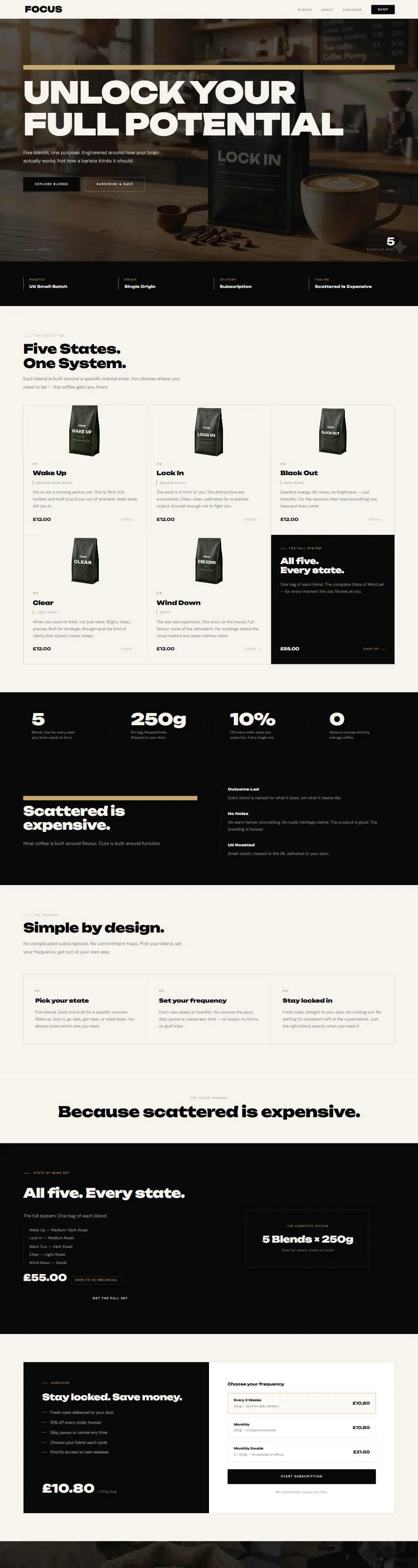
Speciality coffee system
Brand concept, range architecture, copy system, WordPress concept
Coffee framed as a cognitive tool, with five blends mapped to five useful states of mind.
Focus started with a question most coffee brands ignore: what is the coffee actually for?
The entire brand was built around coffee as a cognitive tool. Five blends, each mapped to a specific state of mind: Wake Up, Lock In, Clear, Black Out, and Wind Down.
Mobile Hero
Five States. One System.
Scattered Is Expensive.
Local trade differentiation
Positioning, identity direction, copywriting, custom WordPress site
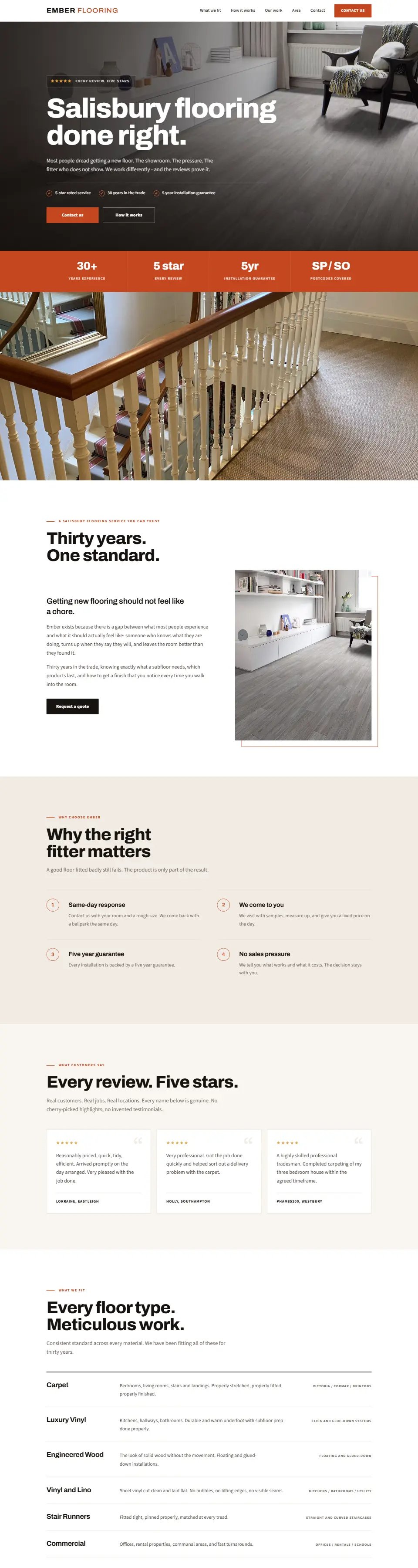
A flooring contractor site built around proof: fixed pricing, long experience, and a cleaner route to enquiry.
Ember had the credentials. Fixed price on the day. Five year guarantee on every installation. None of it was visible on their old site.
The rebrand gave Ember something to say: fixed pricing, a five year guarantee, and a set of proof points stated plainly on the page.
Desktop Homepage
Mobile Hero
Thirty Years. One Standard.
Three Steps. That Is It.
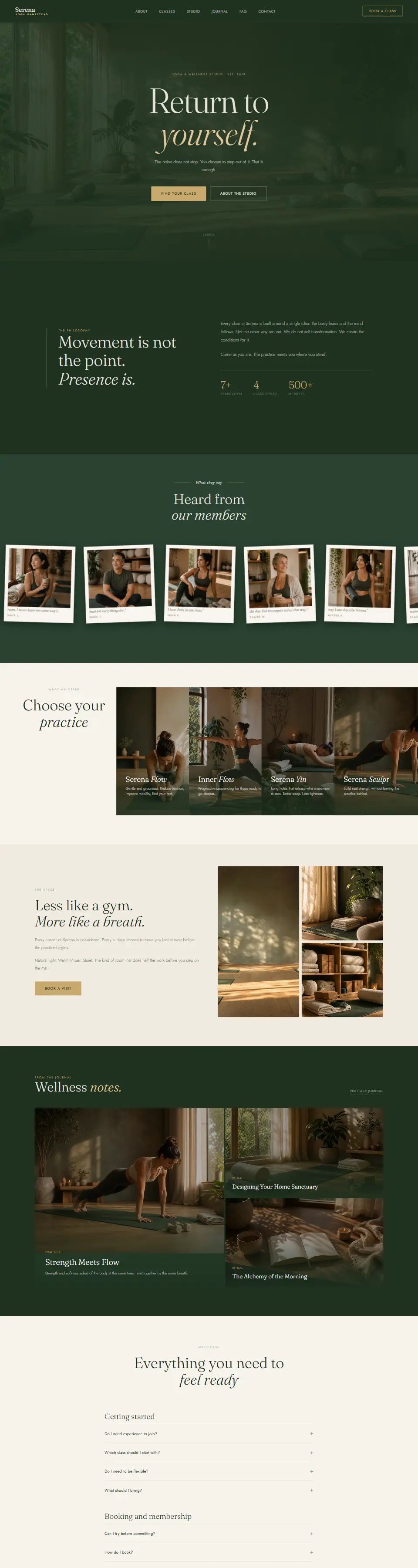
Wellness studio concept
Concept brand, copywriting, editorial structure, custom WordPress theme
A calm, restrained yoga identity built around presence over performance.
Serena Yoga Hampstead is a concept build for a yoga and wellness studio in Hampstead, London. The brief was a complete brand and web system: identity, copy, and a custom WordPress theme.
The identity is intentionally restrained: dark forest green, warm off-white, muted gold, and a wordmark that carries the name without a symbol or flourish.
The copy system is built around one position: presence over performance. The result is a wellness identity that feels premium but not sterile, local but not parochial, and calm without disappearing into the same beige language used across the category.
Desktop Homepage
Mobile Hero
Choose Your Practice
Wellness Notes
AI product for retailers
Product strategy, WordPress plugin development, AI image workflow, WooCommerce integration
A room visualisation plugin built for independent surface retailers who cannot justify enterprise pricing.
Room Visualiser AI began with a gap that was obvious from the shop floor but missing from the software market: independent surface retailers need visualisation technology, but the available tools are priced and packaged for businesses with very different margins.
A tile shop, flooring retailer, or wall covering business does not need another enterprise platform with onboarding fees, SKU limits, and fixed render quotas. It needs a simple way for a customer to stand in their own room, look at the product they are considering, and feel the decision become easier.
The plugin does exactly that. On the product page, the customer taps See it in your room, uploads or photographs their space, and within seconds sees the floor replaced with the selected product. It happens directly inside WordPress, on any device, with no app to download and no account to create.
The important part is not just the image generation. It is the buying moment around it. Lighting, shadow, and perspective are preserved so the result feels connected to the original room instead of pasted on top of it. A Hold to compare function lets the customer toggle between the original floor and the visualisation, making the change easier to trust. They can save the image, try another room, or return to the product with more confidence.
The commercial model was treated as part of the product, not an afterthought. Platforms such as Wizart and Roomvo can start at $255 a month, with setup fees up to $525, SKU limits, and fixed render quotas. That structure makes sense for some large catalogues, but it creates the wrong pressure for an independent showroom doing modest online traffic.
Room Visualiser AI removes those barriers. It installs like a normal WordPress plugin. Retailers pay one flat monthly fee with no setup cost, no SKU limits, and no render quotas. Five renders per visitor session keeps usage generous for shoppers and predictable for the retailer.
Under the hood, the plugin uses Google's Gemini image model via fal.ai. The technical work sits quietly behind the interaction: product context, customer uploads, prompt handling, session limits, image generation, comparison behaviour, and save flow all have to feel simple because the customer is not there to admire the software. They are there to decide whether the floor belongs in their home.
Built and developed by Wild Mint Studio, Room Visualiser AI is shown here as a practical example of a sharper kind of product build: not novelty AI, not enterprise theatre, but useful technology priced for the businesses that actually need it.
Marketing concept
Campaign concept, brand analysis, outdoor advertising idea, World Cup positioning
A self-initiated World Cup advertising concept exploring how a brand can be recognised through culture, image, and discovery instead of explanation.
The project began with a simple advertising observation: the strongest brands do not always need to introduce themselves. McDonald's proved that with a Calgary Stampede billboard that showed a red cowboy jacket with yellow fringe. The image looked native to the event, but the fringe slowly resolved into French fries. No product shot. No headline. No offer. The viewer completed the ad.
That became the strategic test for this concept. Could the same mechanic work for another brand with enough recognition, visual memory, and cultural permission behind it?
Budweiser was the right candidate. It has decades of association with football, celebration, stadiums, red, beer, and the crown. The concept did not need to force the brand into the World Cup. It needed to reveal a place where the brand already felt present.
The first route used the goal net as the frame and placed a crown above the ball, built from stadium light and atmosphere. It had drama, but the crown was too explicit. It read like a placed symbol rather than something discovered. The idea needed more restraint.
The final route removed the obvious mark and let the scene do the work. From inside the goal, the net is still moving after a shot. The crowd becomes a golden blur behind it. The red tint at the edges carries Budweiser without naming it. The stadium lights form the suggestion of a crown only after you spend a moment with the image.
One word completes the thought: REIGN.
The Budweiser logo sits small in the corner because the image has already done the brand work. That is the point of the project. The ad does not describe the brand. It demonstrates the brand's right to exist inside the moment.
The wider lesson is not limited to billboards. Six seconds, one scroll, one subject line: the mechanism is the same. Stop explaining everything. Build the moment well enough that people want to find the idea for themselves.
McDonald's Reference
Earlier Crown Route
Final REIGN Concept
Marketing concept
Campaign concept, visual idea, brand recognition, World Cup advertising series
A minimal Adidas World Cup concept where three player shadows become the brand, without product, strapline, or explanation.
The Adidas concept followed the same rule: the brand had to be recognisable enough to disappear. Not absent, but embedded so deeply in the moment that the audience finds it before the logo tells them what they are seeing.
Adidas clears that bar because it does not need to insert itself into football. It is already there: on the ball, on the boots, on the shirts, and in the visual memory of the game.
The concept is three players walking out of a tunnel onto the pitch. The camera sits low, almost flat to the turf. Golden hour sun burns behind them and the stadium opens ahead. Three shadows stretch toward the viewer across the grass, long, clean, and parallel.
Three stripes.
No product shot. No tagline. No explanation. Just a small Adidas logo in the bottom corner, quiet enough that you almost miss it.
Most brands would keep adding things: make the logo bigger, show the boot, add a URL, explain the thought. That is why most tournament advertising is forgotten almost immediately. This concept is about the confidence to trust the image, trust the audience, and get out of the way.
Three Shadows. Three Stripes.